“What’s your MOQ?” is often the first question a new jewelry brand asks a manufacturer — and one of the most misunderstood. Minimum Order Quantity can make or break whether a small or emerging brand can even get started with a manufacturing partner. Here’s what it actually means, why it varies so much, and how to approach the conversation.
MOQ Isn’t a Fixed Number Across the Industry
Unlike a published price list, MOQ is rarely a single fixed number — even within the same factory. It typically depends on:
- The complexity of the design — a simple band requires far less setup than an intricate multi-stone piece
- The materials involved — custom stone-cutting or rare gemstone sourcing raises the practical minimum
- Your relationship with the manufacturer — an established, ongoing partnership often unlocks lower minimums than a first-time one-off order
- The manufacturer’s own production model — some factories are built for large wholesale runs only, while others (like ours) assess MOQ based on the client’s scale and mutual agreement, making room for smaller or growing brands
This is why asking “what’s your MOQ” as a first message rarely gets a useful answer — it depends on what you’re actually trying to make.
Why MOQ Exists in the First Place
MOQ isn’t arbitrary gatekeeping — it reflects real production economics:
- Setup costs — preparing molds, prototypes, and material sourcing has a fixed cost regardless of order size, so very small orders can become unprofitable for the manufacturer to run
- Material minimums — suppliers of gold, diamonds, and gemstones often have their own minimum purchase quantities that get passed down the chain
- Labor efficiency — skilled jewelry-making labor is more efficient in batches than one-off pieces
Understanding this helps reframe the conversation: instead of asking a manufacturer to simply “lower” their MOQ, it’s often more productive to ask what design or material adjustments could bring a smaller order within reach.
Questions to Ask Before You Commit
When evaluating a manufacturing partner, go beyond the MOQ number itself:
- Does MOQ apply per design, or per order across multiple designs? Some manufacturers allow you to mix several designs to reach a combined minimum — which is far more useful for a new brand testing multiple products at once.
- Is the MOQ different for reorders? A manufacturer that simplifies the process for repeat orders (rather than treating every order as a first-time negotiation) is a strong sign of a partnership built for growth, not just a single transaction.
- Can MOQ change based on gold karat or gemstone choice? Simpler material choices sometimes unlock smaller minimums.
How to Start Small Without Overcommitting
If you’re a new or small brand, a few practical strategies can help:
- Start with fewer designs at a workable minimum, rather than spreading a small budget across many designs that never reach volume pricing
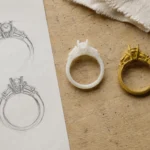
- Ask about sampling before committing to full MOQ — a manufacturer that provides 3D renderings or physical prototypes before production lets you validate a design without the risk of a full minimum order
- Build a relationship, not just a transaction — manufacturers are often more flexible with MOQ for clients they expect to grow with over time
Our Approach
We don’t publish a single fixed MOQ, because we don’t believe one number fairly represents every client. Instead, we assess minimum order quantity based on your company’s scale and reach a mutual agreement that works for both sides — which means a growing brand placing its first order is evaluated differently than an established wholesale buyer placing a repeat one.
If you’re trying to figure out what a realistic starting order would look like for your brand, get in touch with our team. We’ll walk through your designs and find a starting point that makes sense for where your brand is today.