If you’re launching or expanding a jewelry brand, one of the first technical decisions you’ll face isn’t about design — it’s about gold purity. Should your line be 9K, 10K, 14K, or 18K? The answer has less to do with “better vs worse” and more to do with matching your product to your market. Here’s how to think it through.
First, What Do the Numbers Actually Mean?
Gold karat measures purity — how much of the metal is actually gold, versus alloyed with other metals like copper, silver, or zinc for strength and color.
- 24K — 99.9% pure gold. Very soft, rarely used for everyday jewelry.
- 18K — 75% gold. A common standard in Asia, the Middle East, and for fine/bridal jewelry worldwide.
- 14K — 58.3% gold. The most popular choice in the US market, balancing durability and gold content.
- 10K — 41.7% gold. The legal minimum to be called “gold” in the US, prized for durability and affordability.
- 9K — 37.5% gold. Common in the UK and parts of Europe, offering the most durability and the lowest price point.
There is no universally “correct” karat — different regions have different expectations, shaped by tradition, price sensitivity, and even legal definitions of what can be sold as gold.
Match Karat to Your Target Market
This is the single biggest factor, and it’s where many new brands go wrong by assuming one karat fits every customer.
- Selling to the Middle East or parts of Asia? 18K (or higher) is often the expectation — customers associate higher karat with higher value, and daily-wear habits favor gold that doesn’t need constant color-plating.
- Selling to the US or Canada? 14K is the market standard — durable enough for everyday wear, priced accessibly, and instantly familiar to consumers.
- Selling to the UK or parts of Europe? 9K is common and well accepted, particularly for fashion-forward or younger-skewing brands where price point matters more than gold content.
If you’re selling across multiple regions, it’s worth offering the same design in more than one karat rather than forcing one standard on every market.
Durability vs. Price: The Real Trade-Off
Lower karat gold (9K, 10K) is alloyed with more non-gold metal, which makes it harder and more scratch-resistant — genuinely useful for rings and bracelets that see daily wear and impact. Higher karat gold (18K+) is softer and shows wear more easily, but carries a richer color and higher perceived value.
Neither is objectively better — it’s a trade-off between everyday durability and gold content/prestige, and the right answer depends entirely on how your customer will actually wear the piece.
Color Considerations
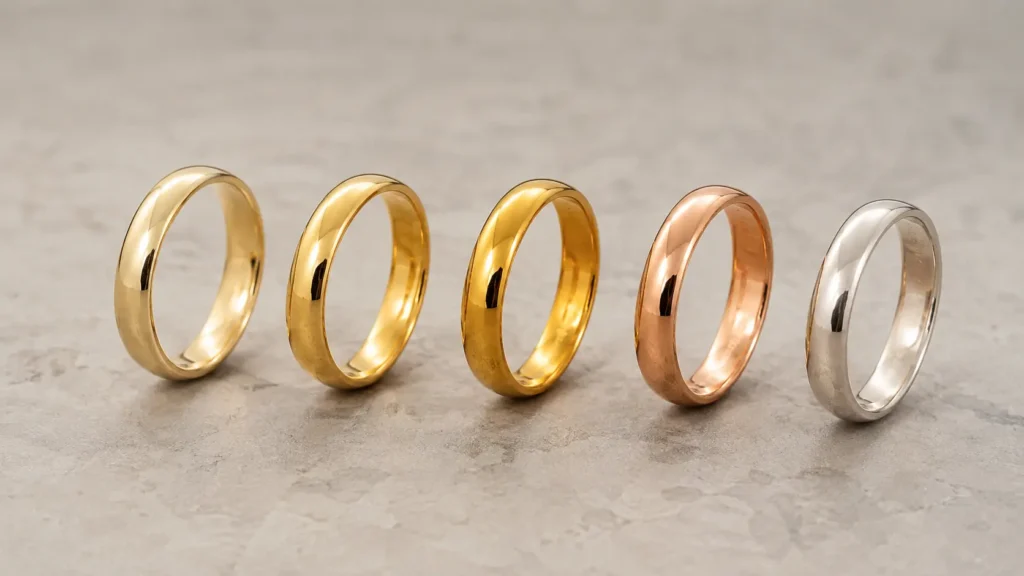
Karat and color are related but separate decisions. Within any karat, you can typically choose:
- Yellow gold — the traditional, warmest tone
- White gold — alloyed and often rhodium-plated for a bright silver-white finish
- Rose gold — alloyed with more copper for a warm pink hue
A design that works beautifully in 18K yellow may need adjustment in 9K white, since the alloy mix changes slightly by karat. This is worth discussing with your manufacturer early, not after production has started.
A Practical Starting Point
If you’re unsure where to begin, a common approach for new brands is:
- Pick one core karat that matches your primary target market
- Launch your first collection in that karat only, to keep production and inventory simple
- Expand into additional karats once you understand demand — rather than guessing upfront across five options
Work With a Manufacturer That Offers Full Flexibility
The ideal setup is a manufacturing partner who can produce the same design across 9K, 10K, 14K, and 18K without retooling — so you’re not locked into one market from day one, and can expand as your brand grows.
At Gold Jewelry Factory, every applicable design in our catalog is available across all four gold karats, plus sterling silver, as a simple specification choice — not a separate product line. If you’re deciding which karat is right for your brand, reach out to our team — we’re happy to talk through what fits your market best.